

Fish Hook and Splinter Removal Treatment in Northwest Houston TX
A deeply embedded splinter or fish hook can cause pain, swelling, bleeding, and infection risk if you can’t remove it safely at home. At Precise Urgent Care, Dr. Rajan Popat, MD, FACEP, and our team provide careful evaluation and removal of appropriate superficial foreign objects while protecting the surrounding skin and tissue. Our clinic also evaluates the wound for signs of infection, tissue damage, and other concerns so patients in Northwest Houston can receive timely, individualized care and appropriate aftercare guidance. For more information, contact us or use online check-in. We are conveniently located at 22545 State Highway 249 Suite 130, Houston, TX 77070.
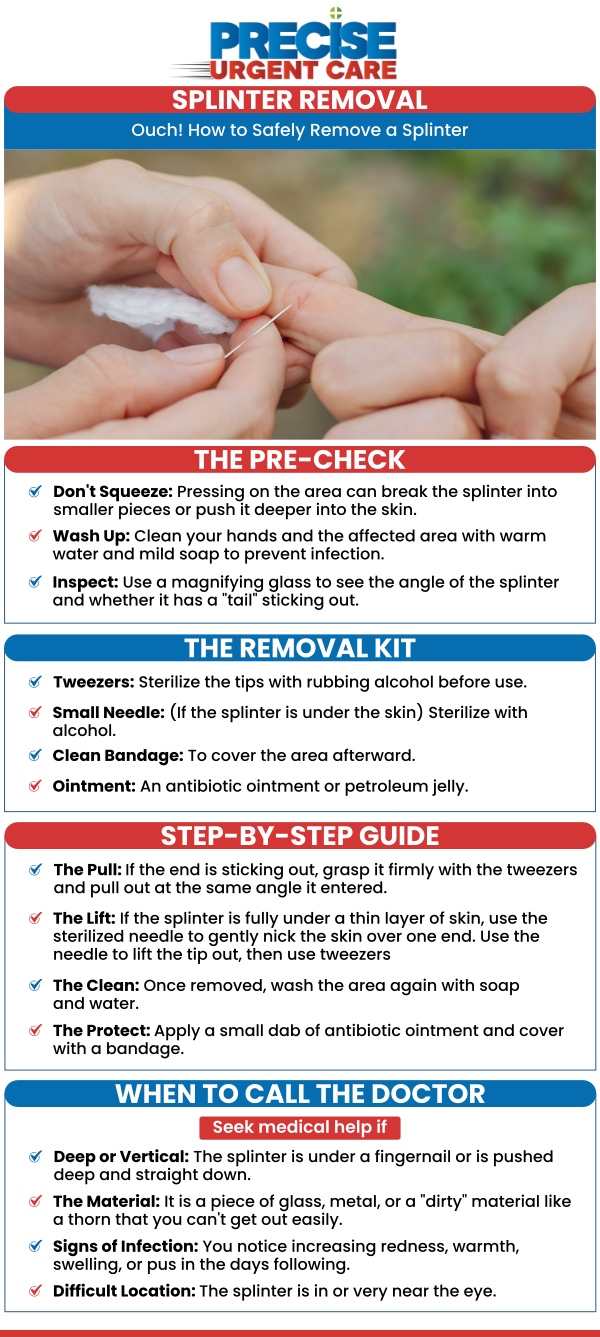
Table of Contents:
What should I do if I get a fish hook stuck in my skin?
When should I seek medical help for a fish hook or splinter removal?
Can a fish hook cause infection if not removed properly?
How do doctors safely remove fish hooks or splinters in urgent care?
How Can Dr. Rajan Popat, MD, at Precise Urgent Care Help Reduce Complications During Foreign Object Removal?
If a fish hook becomes stuck in your skin, avoid pulling, twisting, or forcing it out, especially if the barb is embedded. Keep the injured area as still as possible and gently clean around the wound with soap and water without pushing the hook deeper. Attempting aggressive removal at home can increase bleeding, tissue damage, or the chance of leaving part of the hook behind.
Professional medical evaluation is recommended when the hook is deeply embedded, difficult to remove, contaminated, or located near the eye, face, joint, tendon, nerve, or blood vessel. At Precise Urgent Care, our skilled team can evaluate the depth and position of the hook and determine an appropriate removal approach. Local numbing may be used when appropriate to improve comfort while the hook is removed with controlled technique and proper instruments.
You should seek professional medical care when a fish hook or splinter cannot be removed easily or when the injury involves a higher risk of infection or tissue damage. Medical evaluation is especially important if:
• The fish hook or splinter is deeply embedded in the skin.
• The object is located near the eye, face, joint, tendon, nerve, or another sensitive area.
• Part of the object has broken off and remains under the skin.
• Bleeding continues despite applying steady pressure.
• You develop increasing redness, swelling, warmth, drainage, or worsening pain.
• You notice numbness, tingling, weakness, or difficulty moving the affected area.
• The wound was caused by a dirty, rusty, or contaminated object.
• You are unsure whether your tetanus vaccination is up to date.
• Previous attempts at removal have caused additional pain, bleeding, or tissue injury.
At Precise Urgent Care, our team can evaluate the location and depth of the foreign object, remove it using appropriate techniques, and check the wound for retained fragments or signs of infection. We can also review your tetanus vaccination status and provide aftercare guidance to support safe healing and reduce the risk of complications.
A fish hook can increase the risk of infection if it is not removed completely or if the wound is not properly cleaned afterward. Because the hook punctures the skin, bacteria from the hook, surrounding environment, water, or skin can enter the wound. Infection risk may be higher when the hook is contaminated, deeply embedded, or when part of the hook breaks off and remains beneath the skin.
Signs of a developing infection may include increasing redness, swelling, warmth, tenderness, drainage, or worsening pain around the injury. Fever, red streaking from the wound, or rapidly increasing swelling may indicate a more serious problem and should be evaluated promptly. Improper removal can also cause additional tissue damage or leave fragments behind, which may delay healing and increase complications.
At Precise Urgent Care, our team can carefully evaluate fish hook injuries, remove embedded hooks when appropriate, clean and assess the wound, and check for retained fragments or other concerns. We can also review tetanus vaccination status and provide individualized aftercare recommendations. Seeking timely care when a hook is difficult to remove or when infection symptoms develop can help support safer healing and reduce the risk of complications.
Doctors typically begin by examining the area to determine the object’s size, depth, direction, and proximity to nerves, tendons, joints, blood vessels, or other sensitive structures. The skin is cleaned carefully, and local numbing may be used when appropriate to reduce discomfort. The removal method depends on whether the object is a straight splinter, barbed fish hook, or another type of embedded foreign body.
For splinters, a clinician may use sterile forceps or make a very small opening in the skin when needed to expose and remove the object without unnecessary tissue damage. Fish hooks may require a different technique based on how deeply the barb is embedded and where the hook is located. The goal is to remove the entire object while minimizing bleeding, pain, and injury to surrounding tissue.
After removal, the wound is cleaned and checked for retained fragments, infection, or deeper injury. At Precise Urgent Care, our team provides appropriate wound-care instructions and guidance for safe healing. Patients are advised to watch for increasing redness, swelling, drainage, fever, worsening pain, or other signs that the wound may need further medical evaluation.
Dr. Rajan Popat, MD, uses careful clinical evaluation to determine the location, depth, and type of foreign object before removal. Whether the concern involves a splinter, fish hook, or another superficial object, he considers factors such as surrounding tissue injury, bleeding, contamination, pain, and possible involvement of deeper structures. This methodical approach can help reduce unnecessary tissue trauma, incomplete removal, and other complications that may occur when embedded objects are pulled out without proper assessment.
At Precise Urgent Care, Dr. Rajan Popat, MD, works with our team to provide controlled foreign object removal and appropriate wound evaluation for patients in Northwest Houston. After removal, our clinic can assess the area for retained fragments, infection risk, and signs of additional injury while providing individualized aftercare guidance. Patients with complex, deeply embedded, or high-risk foreign objects can also be directed to a higher level of care when needed, helping support safer treatment and recovery. For more information, contact us or use online check-in. We are conveniently located at 22545 State Highway 249 Suite 130, Houston, TX 77070. We serve patients from Northwest Houston TX, Klein TX, Jersey Village TX, Willowbrook TX, Cypress TX, Tomball TX, and surrounding areas.

Check Out Our 5 Star Reviews


Additional Services You May Need
▸ Urgent Care
▸ Injury
▸ Fever
▸ Dehydration
▸ Vomiting
▸ Diarrhea
▸ Allergies
▸ Rashes
▸ Ear Pain
▸ Pre-Employment Physical
▸ DOT Physicals
▸ Sports Physicals
▸ STD/STI Testing
▸ Shockwave Therapy OmniWave

Additional Services You May Need
▸ Urgent Care
▸ Injury
▸ Fever
▸ Dehydration
▸ Vomiting
▸ Diarrhea
▸ Allergies
▸ Rashes
▸ Ear Pain
▸ Pre-Employment Physical
▸ DOT Physicals
▸ Sports Physicals
▸ STD/STI Testing
▸ Eye Redness / Pain
▸ Back Pain
▸ Mild Head Injuries
▸ Urine Infections (UTI)
▸ Cough
▸ Sore Throat
▸ Sinus
▸ Asthma
▸ Stitches
▸ Drug Screening
▸ Tuberculosis Testing (PPD)
▸ EKG Testing
▸ Ear Wax Removal
▸ Laceration Repair
▸ Burns
▸ Abscesses
▸ Fish Hook & Splinter Removal
▸ Splinting
▸ Back Injury
▸ Fractures
▸ Sprains & Strains
▸ Workers’ Compensation
▸ X-Ray
▸ Vaccinations
▸ IV Therapy
▸ School Physical
▸ Shockwave Therapy OmniWave


 Send Text
 How May I Help You?